UK MMA Betting and Live UFC Odds Comparison
Eleven years of UK octagon coverage, distilled into a single reference for UKGC-licensed markets, 2025 regulation, and the math that shapes every price on your slip.
 Available in US
Table of Contents
- Comparing UKGC-Licensed Bookmakers for MMA Betting Odds
- What to Take Away Before You Place a Slip
- The UK MMA Betting Market, in Numbers
- What Changed in UK Gambling Rules for 2025 and 2026
- How to Spot a Genuinely UKGC-Licensed MMA Bookmaker
- Core MMA Markets You Will See on Every UK Site
- Reading UFC Odds and Bookmaker Margin Like an Analyst
- Why the UFC Matters So Much to UK Bettors Right Now
- PFL, Bellator, KSW, Oktagon and Cage Warriors: The Wider UK Card
- Where to Watch the Fights You Are Betting On
- Responsible Gambling: What the Data Says and What To Do
- A Sober Strategy Primer Before Your First Slip
- Frequently Asked Questions
- The Bottom Line for UK Fight Fans
Comparing UKGC-Licensed Bookmakers for MMA Betting Odds
The first time I watched the O2 Arena roar for a home-card UFC Fight Night, I was sitting at a laptop in an office in Manchester, tracking the live market at six different British books whilst Tom Aspinall was warming up backstage. Three of them suspended at different points in round one. Two left the moneyline live for another eight seconds after a knockdown that everyone in the arena had already seen. That three-second delta is the entire subject of this article, multiplied across eleven years.
Most guides written for the British punter on MMA betting read like they were translated from an American template. They are not. The UK market runs on its own rails. UKGC-licensed books price differently to Vegas books. UK tax law treats punters differently. The regulation sitting underneath your next UFC slip has shifted more in the last eighteen months than in the decade before it.
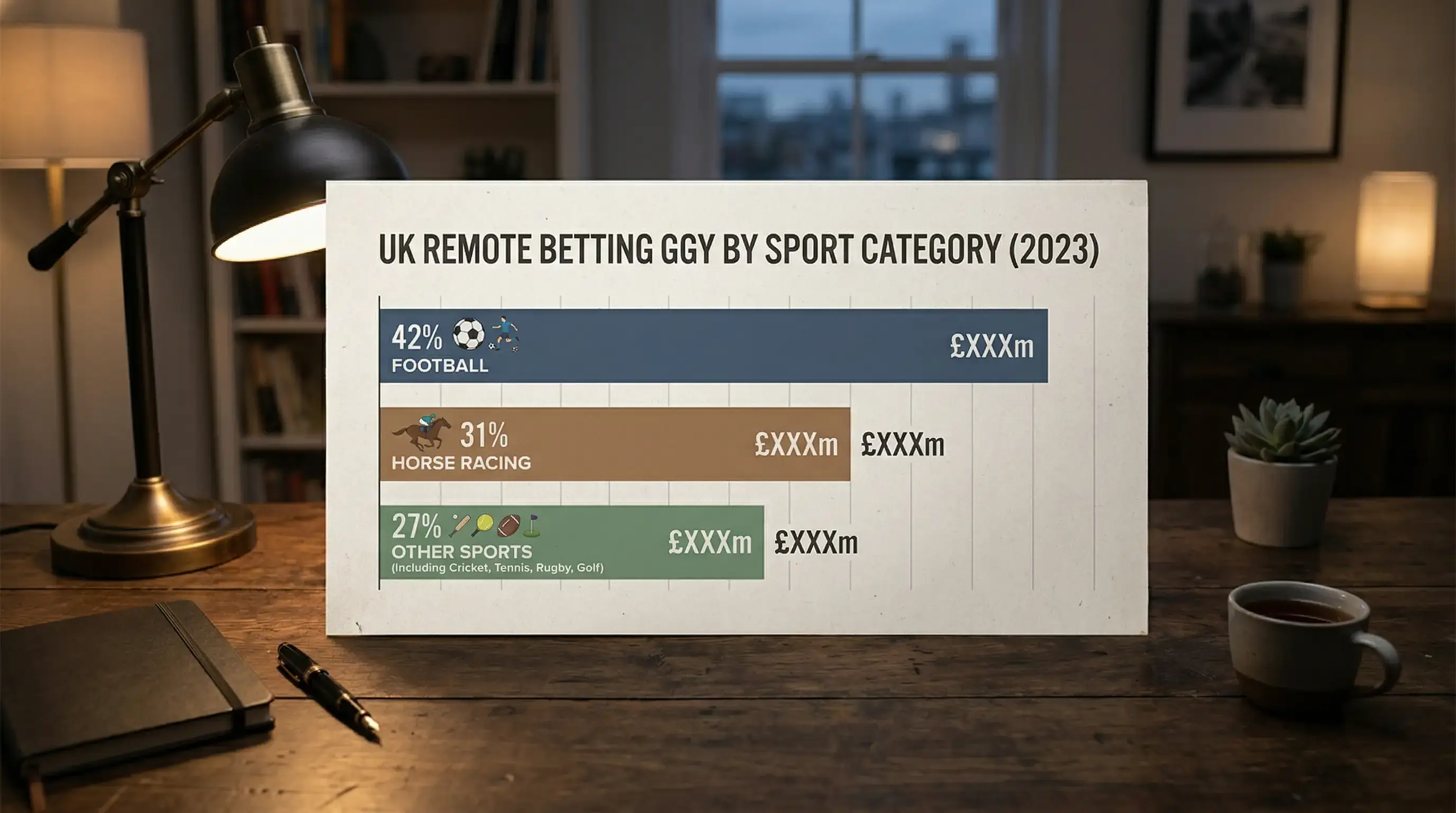
The numbers that frame this story are worth keeping in your head. Remote betting in Great Britain pulled £2.6 billion in Gross Gambling Yield in 2024/25, with football dominating at £1.3 billion, horse racing at £766.7 million, and mixed martial arts sitting inside the “Other sports” bucket regulators do not break out. MMA is not a rounding error — it is a growing slice of that line — but you will not find it on the UKGC’s headline dashboards. You have to triangulate.
In 2023 alone, the UFC staged 20 sold-out arena cards worldwide, with seven of those ranking among the top twenty highest-grossing events in the promotion’s history. Total UFC revenue that year crossed $1.3 billion — and it has climbed every year since.
If you are looking for a list of “the ten best UFC bookmakers,” close the tab. This is not that article. What you will get instead is the structure of the UK market, the regulation that shapes it, the math that governs your bets, and the behavioural signals that separate a profitable decade from a painful one.
What to Take Away Before You Place a Slip
- British remote betting GGY sits at £2.6 billion, with MMA buried inside “Other sports” — a growing share driven by 13.5 million monthly active online accounts.
- The 2025 reset is real: a 1.1% statutory levy, slot stake caps, and a mandatory deposit-limit prompt from 31 October 2025.
- Favourites win around 72% of UFC bouts; co-main upsets hit roughly 40%. Variance punishes undisciplined stake sizing.
- Verify every UKGC licence against the public register, and keep unit sizes at 1–3% of bankroll.
The UK MMA Betting Market, in Numbers
Here is a question I get asked at least once a week in DMs: “How big is MMA betting in Britain, actually?” The honest answer is that nobody can tell you the exact figure, because the UKGC does not publish MMA as its own line item. What they do publish is the shape of the market around it, and once you see where MMA sits inside that shape, the picture snaps into focus.
Great Britain’s entire gambling industry produced a Gross Gambling Yield of £16.8 billion in the 2024/25 reporting year, up 7.3% on the prior period. Remote Casino, Betting and Bingo — the online slice that includes everything you do from a mobile or laptop — accounted for £7.8 billion of that total, a 13.1% jump year on year, and now makes up 46% of the entire British gambling market. Online has crossed the threshold where it is no longer the challenger channel. It is the channel.
Within that, remote real-event betting — the category that actually contains your UFC bets — hit £2.6 billion GGY. Football took the lion’s share at £1.3 billion. Horse racing followed at £766.7 million. MMA, along with tennis, cricket, boxing, golf and everything else that is not football or the horses, is bundled into the “Other sports” pool. Industry-side estimates I have seen place MMA somewhere in the £60–110 million GGY band for UK remote books, but I will not anchor you to a number the regulator does not publish.
£16.8 bn
Total GB gambling GGY, 2024/25 (UKGC)
£7.8 bn
Remote casino, betting and bingo GGY (+13.1% YoY)
£2.6 bn
Remote real-event betting GGY
13.5 m
Average monthly active online accounts
23.4 bn
Bets and spins placed in a single quarter
The activity metrics do most of the storytelling. 13.5 million average monthly active online accounts is not a typo. That is one account for every five adults in Britain logging in within a given month. Operator data shows 23.4 billion bets and spins placed across a single quarter, with roughly 290 million real-event bets per month. MMA is a sliver of that, but a sliver of a very big pie.
Who Actually Operates in This Market
The operator count has clearly contracted. Licensed operators fell to 2,179 as of 31 March 2025, down 3.7% year on year. Bricks-and-mortar betting shops have shrunk for eleven consecutive quarters, landing at 5,825 premises. Tighter compliance requirements make a small book unviable and push activity onto larger, multi-brand licensees. Flutter Entertainment — Paddy Power, Betfair, Sky Betting & Gaming — was on track for roughly £2.36 billion in UK revenue for 2025 alone. William Hill and Bet365 together command over 50% of UK sports betting PPC inventory.
What “GGY” actually means. Gross Gambling Yield is the money operators keep after paying out winnings but before costs and taxes. When the UKGC says £2.6 billion in remote betting GGY, that is the aggregate margin the books held onto across every sport they priced.
Two behavioural stats matter before we leave this section. 95% of UK online bets are placed from home. Among mobile-first bettors, 32% sit in the 18–24 bracket. The profile of a modern British MMA bettor is a young adult on a phone, at home, often in play. Every product decision, every regulatory lever, and every pricing model flows from that reality.

What Changed in UK Gambling Rules for 2025 and 2026
Ask any compliance officer at a British book what kept them up at night in 2025 and you will hear three dates. 6 April. 9 April. 31 October. Those three dates reshaped UK online betting more than anything since the 2005 Gambling Act. If you placed a UFC bet in December 2024 and another one last week, you have already felt the difference, even if you did not know what you were looking at.
Britain finally implemented the bulk of the 2023 Gambling Act White Paper. A statutory levy replaced the old voluntary industry contribution. Online slots got hard stake caps. Every new bettor now has to be prompted to set a deposit limit before funding their account. None of these changes are cosmetic, and each one ripples through to the MMA markets you place on.
The Statutory Levy
From 6 April 2025, the Gambling Levy Regulations 2025 came into force. Online operators — every UKGC-licensed book carrying UFC odds — now pay 1.1% of their GGY into a central research, prevention and treatment fund. Land-based rates are lower, tiered at 0.5%, 0.2%, and 0.1%. The expected fund size for 2025/26 is £90–100 million, administered with UK Research and Innovation and NHS bodies. That is the first time research funding for gambling harm sits on a statutory footing in Britain.
Baroness Twycross, the Minister for Gambling, described the levy in Parliament in February 2025 as “a watershed moment: a significant uplift in the investment dedicated to this area; greater government oversight; and a renewed commitment to further understanding, tackling and treating gambling harms.”
Will the 1.1% show up in worse odds for you? Almost certainly no. Book margins on major UFC fights already sit well above 1.1%. The levy is a cost the books absorb, not a lever they use to widen spreads on a specific fight.
Slot Stake Caps and the 18–24 Line
From 9 April 2025, a hard stake cap came in for online slots: £5 per spin for players 25 and over, and £2 for anyone aged 18–24. Slots, not sports betting — but it matters for MMA punters. Many UFC bettors use the same operator for both verticals, so your casino tab and your sportsbook tab now behave differently. The regulator has signalled that age-banded limits are a tool it is willing to use — expect similar conversations about sports betting limits for younger cohorts over the next two years.
The Deposit Limit Prompt
This is the big one for new punters. From 31 October 2025, every UK operator must prompt every new customer to set a financial deposit limit before that customer makes their first deposit. You can skip the prompt — it is opt-out, not a gate — but the presence of the prompt is now mandatory. UKGC CEO Andrew Rhodes put it plainly: “From the end of this month our new rules will give consumer controls over deposit limits and all gambling businesses must prompt their customers to set a financial limit before they make their first deposit.”
Affordability checks, the light-touch version. From 2025, players depositing over £150 net per month into a single operator are flagged for light-touch financial vulnerability checks. These are supposed to be silent, using publicly available data, with the operator only escalating if risk signals fire. If your favourite book suddenly asked for a payslip after a big month, this is the trigger sitting underneath it.
I have written at length elsewhere about how these changes interact. For a proper walkthrough of the regulatory stack and the individual mechanics, see the deep dive on UK MMA betting regulation and responsible gambling. What matters here is the direction of travel. UK gambling regulation is getting tighter, more data-driven, and more interventionist on the consumer side. That will not reverse in 2026.

How to Spot a Genuinely UKGC-Licensed MMA Bookmaker
A mate of mine — a sharp bettor, full-time numbers guy — nearly lost the lot to an offshore site in 2018 that had Union Jacks all over the homepage and absolutely no UKGC licence. He got three good months in, asked to withdraw £4,800, and watched the cashier tab cycle “pending” for seventy-one days. The UK licensed that domain out of existence eventually. But between the day he deposited and the day the site went dark, UKGC protections did precisely nothing for him, because he was not a customer of a UKGC-licensed operator. He just thought he was.
The Mechanical Licence Check, in Four Steps
Before you fund any new UK MMA bookmaker, run these four checks.
- Find the operator’s licence number in the site footer. A real UKGC licensee displays the account number and a link to its Gambling Commission public register entry. If it is not in the footer or terms, walk away.
- Cross-check that number on the UKGC public register directly. Do not trust the operator’s own linked badge — open a fresh tab, type the register URL, and search by operator or account number.
- Verify the registered company name matches the licence holder. If the brand on the site is not listed as a trading name on the licence, that is a red flag worth a customer-service email.
- Check the licence status is “Active” and the activities cover “General Betting Standard” or “Remote Betting” — MMA odds sit under these. A licence restricted to lotteries or casino does not cover sports betting.
Four minutes of work, zero financial commitment, and you have eliminated every category of rogue operator in one sweep. It does not matter how sharp the odds are or how generous the sign-up offer looks. Unlicensed means unprotected.
Why the Licence Itself Matters
The UKGC operator count sits at 2,179 as of 31 March 2025, down 3.7% year on year. That declining number is a filter — each operator still on the list is carrying the compliance load that comes with the Licence Conditions and Codes of Practice. Segregated player funds, AML protocols, age verification, GAMSTOP compliance, responsible gambling messaging, dispute resolution through an approved ADR provider, and a public register entry a regulator can cross-reference in real time.
What a real licensee will never ask you to do. A UKGC-licensed book will never offer to “run a bet off the books,” never ask you to deposit via unregulated crypto to a personal wallet, and never require that you wire funds to an individual account name rather than the corporate entity. If any of these requests appear, you are not dealing with the operator you thought you were.
For most bettors, the four-step checklist covers ninety-nine per cent of the risk. Walkthroughs with register screenshots and the list of revoked MMA operator licences live in the regulation cluster.
Core MMA Markets You Will See on Every UK Site
Open any UKGC-licensed sportsbook on UFC fight week and scroll to the fight page. You will see anywhere from eight to forty markets per bout. Casual punters stare at the list and place a moneyline out of decision fatigue. Sharp punters know which markets carry the most margin and which are priced more honestly.
One grounding number before we get into specifics. Favourites win roughly 72% of UFC fights in recent data, so underdogs land 28–30% of the time. Draws happen in under 2% of bouts, which is why most moneyline markets are two-way. Those ratios change everything about which market gives you positive expected value on a given fight.
Moneyline
The simplest market: who wins. Moneyline lines appear in either fractional form (“Fighter A 1/4, Fighter B 3/1”) or decimal form (“1.25, 4.00”). Decimal form is easier to convert to implied probability.
Illustrative moneyline structure. A UFC main event prices Fighter A at decimal 1.40, Fighter B at 3.00. Fighter A’s implied probability is 1/1.40 = 71.4%. Fighter B’s is 1/3.00 = 33.3%. Total = 104.7%. That 4.7% excess is the bookmaker margin — the overround. On a “fair” market you would see 100% exactly. You will never see 100% on a UK book.
Method of Victory
This is where MMA betting gets interesting. Method of Victory splits the fight outcome by how it ends: KO/TKO, Submission, or Decision. UK books typically price all three paths for each fighter, giving you six main options. Method forces you to engage with the stylistic matchup, not just the aggregate win probability.
Method of Victory — a wager on both the winner and the way the fight finishes. Losses on the method can occur even if your fighter wins (e.g. you picked “KO” but got a “Decision”).
The pricing has structural quirks. Decision prices are often shorter than raw finish-rate data would suggest, because books hedge the long tail of styles that go the distance. KO prices tend to be slightly longer than base rates imply, because books bake in that heavy bettors pile onto “A to win by KO” with emotional money. I have seen consistent inefficiencies in the Decision market on lower-card bouts where the book has not updated pricing for stylistic matchups at short notice.
Round Betting and Totals
Round betting prices each individual round as the finishing round (“Fight ends in Round 2”). Totals over/under is simpler: over/under 1.5 rounds, 2.5 rounds. Three-round bouts and five-round main events have different distribution shapes — five-rounders inflate Decision probability substantially — so do not treat a title fight like a co-main.
Bet Builder and Correlated Selections
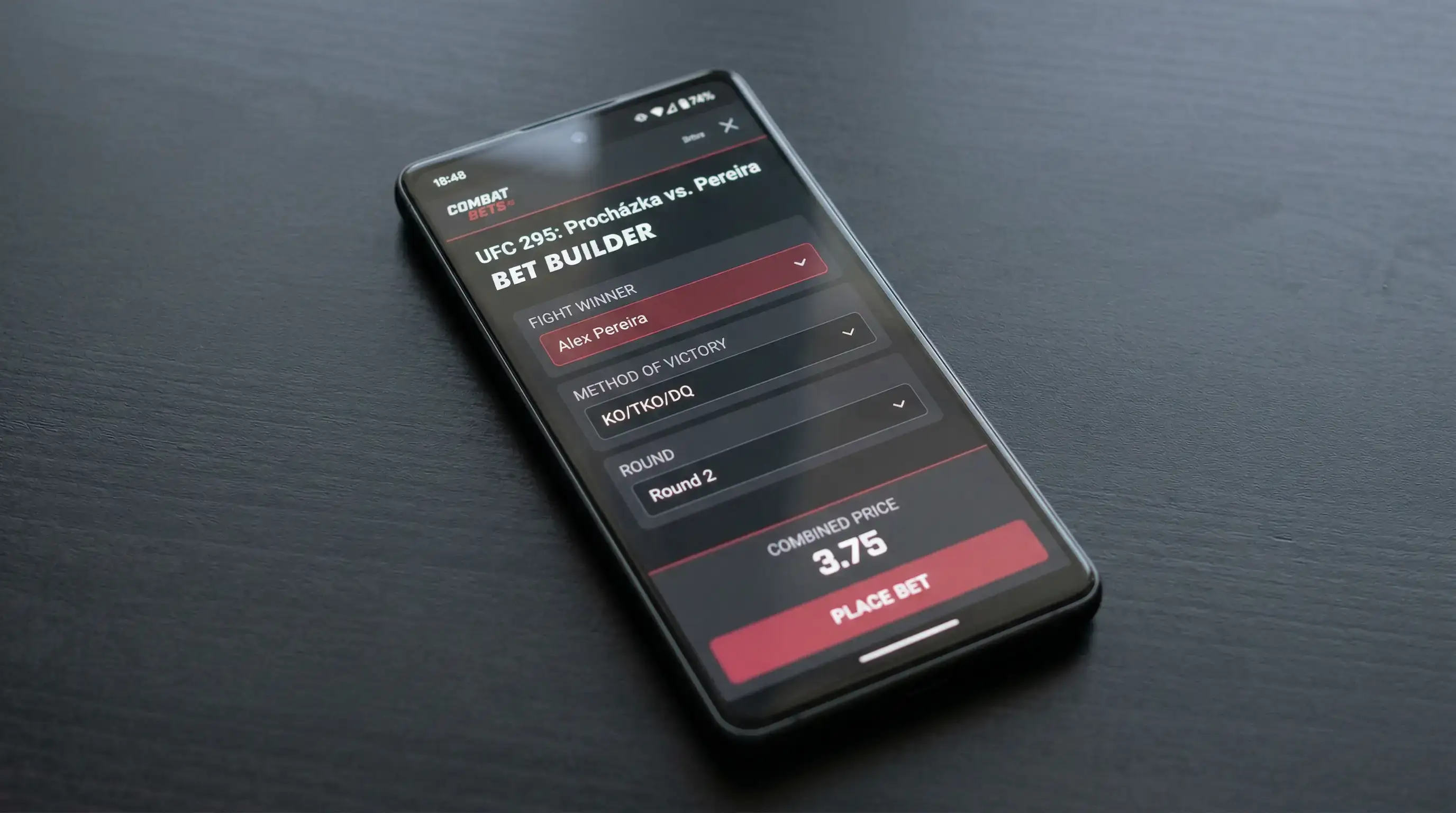
Bet Builder — what the Americans call same-game parlay — lets you combine selections from one fight onto one slip. “Fighter A by KO in Round 1” is a two-leg bet builder. UK books vary enormously in which legs they let you combine and how they handle correlation. Some treat method and round as independent; others correctly correlate them, which gives a shorter combined price but more honest pricing.
For the mechanics of every market, worked examples on Bet Builder correlation, and a round-by-round breakdown of how UK books handle no-contest settlement, see the complete UFC betting markets guide for UK books.
Reading UFC Odds and Bookmaker Margin Like an Analyst
Here is a test I run on new bettors who say they are serious about UFC. Pull up any main event price — a clean favourite at decimal 1.40 and a dog at 3.00. I ask: “What’s the book’s margin?” Most cannot answer. That is not a character flaw — nobody has walked them through it. Knowing the answer is the difference between placing bets blind and placing bets with a calibrated view of what the book thinks.
On major UFC bouts, a sharp UK operator like Bet365 is often priced at roughly a 4% margin — one of the tightest in Britain. On smaller cards and props, you will see margins of 7–12%. The market is not uniform. Knowing where the margin is hiding is half the game.
Decimal to Implied Probability
The single most useful piece of math in sports betting. For decimal odds, implied probability equals 1 divided by the decimal. For fractional odds like 3/1, convert to decimal first: (numerator ÷ denominator) + 1. So 3/1 is 4.00 decimal. 1/4 is 1.25. 5/2 is 3.50. Implied probabilities: 25%, 80%, 28.57%.
Calculating margin on a two-way UFC moneyline.
Step 1. Take the decimal price of each fighter. Assume Fighter A = 1.40, Fighter B = 3.00.
Step 2. Convert to implied probability. A: 1/1.40 = 71.43%. B: 1/3.00 = 33.33%.
Step 3. Sum the implied probabilities. 71.43% + 33.33% = 104.76%.
Step 4. Subtract 100%. Margin (overround) = 4.76%.
Step 5. To estimate “true” no-margin prices, divide each implied probability by the overround. A: 71.43 ÷ 1.0476 = 68.19%. B: 33.33 ÷ 1.0476 = 31.82%. Those are your approximate no-margin probabilities — use them as a benchmark against your own model.
Run this on every fight on a card and you will see UK books do not price evenly. The main event gets the sharpest pricing because the most money goes through it. The prelim dogs often carry a 9–12% margin because the book has less confidence in the line and less liquidity to move it against. That is where patient bettors hunt.
Why Margin Matters More Than You Think
Margin compounds. Bet 100 UFC moneylines a year at an average margin of 5%, with zero skill edge, and your expected loss is 5% of turnover. On a 7% margin book, that becomes seven units per hundred. On £1,000 annual turnover, that is the difference between minus-£50 and minus-£70 before variance.
Books adjust prices based on incoming bet flow. If a price draws too much money on one side, the book moves the line to shade the price down and open the other side. This is why UK UFC odds can swing sharply in the final 24 hours — you are not seeing new information, you are seeing capital flow. Sharp bettors time their bets either very early (catching soft opening lines) or very late (catching overreactions to casual money).
For the full implied-probability walkthrough, a deep look at closing line value, and a breakdown of how UK books compare on margin across market types, see the UFC odds and value betting guide for UK punters.

Why the UFC Matters So Much to UK Bettors Right Now
Ten years ago, UK UFC fans were second-class citizens in the UFC ecosystem. Cards started at three in the morning, British fighters were scattered across the rankings without real contenders at the top, and the promotion treated Britain as a good-weekend-away market rather than a core one. That has completely flipped. The UFC today treats the UK as the most important European market in the world, and it shows up in the data.
UFC earned revenues of $1.502 billion in 2025, up 7% year on year, with an adjusted EBITDA margin of 57%. The UK is the fifth-largest UFC market globally by revenue and the biggest in Europe.
6.84%
UK share of all UFC.com visits (third globally, after USA and Canada)
18,583
UFC London attendance, 22 March 2025
$4.71 m
UFC London live gate — Fight Night record
£110
Cheapest face-value ticket for UFC London 2025
UFC London: A Commercial Marker
UFC Fight Night London on 22 March 2025 at the O2 Arena sold 18,583 tickets for a gate of $4.71 million — a Fight Night record anywhere in the world. Ticket resale traded 30–50% above face value. When I price a UFC London or Manchester card, I factor in a home-crowd effect on certain British fighters. The books know this too, and they will shade prices toward the British fighter because casual money piles on regardless. The inefficiency is usually on the British fighter losing side, not the winning side.
Paramount, PPV, and What It Means for Odds
The biggest structural change coming for UFC fans in 2026 is the Paramount deal. Paramount/CBS signed a seven-year, $7.7 billion media rights agreement with UFC, starting in 2026. The PPV model is being wound down. UFC 326 on CBS in March 2026 averaged 2.47 million viewers across two hours of linear broadcast, peaking at 3.21 million — the largest UFC audience on linear TV since December 2016.
TKO Group CEO Ariel Emanuel said in February 2026 that “TKO’s 2025 results reflect meaningful momentum across both UFC and WWE. Having concluded our second full year since forming TKO, we are extremely well positioned with long-term media rights agreements in place.” The understatement is doing work — Paramount’s $7.7bn commitment reshapes the entire UFC economy.
For UK bettors, TNT Sports remains the exclusive UFC broadcaster for the UK and Ireland. The Paramount deal primarily reshapes the US market, but knock-on effects on roster decisions, fight frequency, and the death of the old PPV cadence will change how often you can bet on major cards. Expect more fights per year and slightly softer lines on middle-tier cards.
The British Fighter Cohort
This is the best generation of British fighters in UFC history. As Fight Matrix put it in September 2025, “With Aspinall ruling the heavyweight division, Edwards and Garry keeping welterweight alive, Pimblett and Allen in top-ten positions, and Mokaev pushing forward at flyweight, Britain’s presence in the UFC has never been stronger.” Aspinall sits at UFC Heavyweight #1 with a 100% finish rate in the UFC. Paddy Pimblett ranks #6 at Lightweight as of 3 February 2026 and pocketed a $200,000 Performance of the Night bonus for his Michael Chandler win.
PFL, Bellator, KSW, Oktagon and Cage Warriors: The Wider UK Card
If you only bet UFC, you are leaving value on the table. UK books carry markets on at least five other MMA promotions with genuine market depth, and two of them — Cage Warriors and KSW — have significantly softer pricing than UFC because the books employ fewer analysts on them. The trade-off is you need to do more of your own research. The upside is a tradesman-like edge on specific fighters and styles.
If you want to get ahead of the UFC curve, watching Cage Warriors is the cheapest edge you can buy. Most fighters on a Cage Warriors card will never make the UFC, but the ones who do tend to be identifiable twelve to eighteen months out, and their opening UFC moneylines are often generous because US-facing books underprice British pipeline talent.
Market availability matters. A prop you can get on a UFC main event — significant strikes, takedowns, knockdown yes/no — will almost certainly not exist on a Cage Warriors card. Plan your market selection around what the book actually offers for the promotion you are betting.
Where to Watch the Fights You Are Betting On
You cannot bet on what you cannot watch — not if you are doing it seriously. UK broadcast rights for UFC sit with TNT Sports as the exclusive domestic broadcaster for UK and Ireland, with PPV cards distributed through TNT Sports Box Office and HBO Max, and UFC Fight Pass serving as the archive service.
The practical question for a bettor is not “what do I subscribe to” — it is “can I see the cage action ahead of the odds feed on my book.” The odds feed is not synchronous with the broadcast. Depending on your stream source you can be anywhere from three to nine seconds behind the actual cage clock. That latency is where a lot of live-bet money goes to die.
How UK MMA broadcast options compare for in-play bettors.
| Broadcast option | Content covered | Latency profile | Relevance to in-play |
|---|---|---|---|
| Linear cable broadcast | Main cards, selected prelims | Lowest latency, typically 3–5 seconds | Best for live betting |
| Broadcaster OTT app | Full card live plus replay | 5–9 second latency common | Usable but lag-prone |
| PPV dedicated streaming | PPV main cards only | Varies with peak load | Acceptable, event-specific |
| Archive service | Library and prelim archive | Not real time | Not suitable for in-play |
If you live-bet UFC, prioritise the broadcast stack with the shortest latency. That is usually a linear cable broadcast on a quality set-top box, not an OTT app on a Wi-Fi connection. The worst case I have logged was an 11-second delay on a cellular mobile connection. In that window, a live market can move from 1.40 to 2.60 based on a knockdown.
Two safest rules I follow: never place a live bet into a market that is still open more than six seconds after a visible grappling exchange ended (if it is still open, the book is probably lagged on its own side); and never chase a knockdown-in-progress bet, because by the time you see it the book has already moved. For the full treatment of cash-out windows, between-rounds markets, and the broader in-play playbook, read the guide to UFC live and in-play betting on UK sites.
Responsible Gambling: What the Data Says and What To Do
I will not pretend this is the sexy section of a betting article. It is the most important one. In eleven years of this work, the single common factor across everyone I have watched blow up their bankroll is that they treated responsible gambling as somebody else’s problem. The numbers below will tell you why that is a mistake.
British data on problem gambling has a methodological split the industry is still arguing about. The Gambling Survey for Great Britain 2024 put the PGSI 8+ rate — the clinical threshold for problem gambling — at 2.7% of adults. The NHS-backed Adult Psychiatric Morbidity Survey for 2023/24, using a different methodology, put the same threshold at 0.4% of the adult population in England. Both figures are defensible. They measure differently.
Ted Orme-Claye at SBC News summarised the disconnect: “Perhaps the Commission and the NHS could come up with a way to standardise this a bit better so we have a more decisive conclusion about what the problem gambling rate actually is.” Until that standardisation happens, you will see the BGC cite the 0.4% number and harm-reduction groups cite the 2.7% number in the same news cycle.
For an individual punter, the methodological argument matters less than this: 8.8% of UK adults are in the “low risk” PGSI category and 3.1% in “moderate risk” — 11.9% of adults carrying some gambling-related risk signal. Problem gambling sits at 6% among men versus 2.8% among women; among 18–24 year olds, it climbs to roughly 10%. In Scottish communities with high deprivation, the rate is 11%, against under 1% in the least deprived areas.
One more number. 12.2% of GSGB 2024 respondents reported suicidal thoughts or attempts within the last year; 5.2% partially or fully attributed those to gambling. Yet among people at PGSI 3 or above, only 6.3% have had a professional diagnosis and 1.0% received specialist treatment. The NHS did log a 130% rise in referrals to specialist clinics between April and September 2024 — nearly 2,000 referrals in six months.
Do
- Set a deposit limit before your first deposit on any new UK book. Do not skip the 31 October 2025 prompt.
- Keep a dedicated betting bankroll, physically separate from your current account and savings.
- Register with GAMSTOP if you need a hard lockout across all UK-licensed operators at once.
- Track every slip in a spreadsheet, including losses. Visibility is the first discipline.
- Use cooling-off periods built into your operator’s account tools if you feel a tilt session coming on.
Don’t
- Do not chase losses by increasing stake size after a losing weekend.
- Do not borrow to fund a bankroll. Ever.
- Do not bet on cards you have not watched or studied. Filler bets are bleed bets.
- Do not ignore early warning signs — irritability, hiding activity, thinking about bets at work.
- Do not assume licensed equals harmless. The licence protects you from the operator, not from yourself.
Grainne Hurst of the Betting and Gaming Council pointed out in November 2025 that “each month, 22.5 million people in the UK enjoy a bet.” That frames the scale: gambling participation is a mass-market activity in Britain, and the vast majority of participants do so without developing harm. The job of regulation is to protect the minority who do; the job of every individual bettor is to stay on the safe side of that split by design.
Always remember: 18+. When the fun stops, stop. Free confidential support is available 24/7 through GAMSTOP, GambleAware, and the National Gambling Helpline.

A Sober Strategy Primer Before Your First Slip
Most losing bettors do not lose because they pick the wrong fights. They lose because they stake badly. Variance in MMA is brutal — a 30% underdog rate across all UFC bouts, climbing to roughly 40% on co-main events, means that even a bettor with a clean 55% win rate on picks can have three-fight losing streaks that feel like the world has ended. If your staking plan cannot absorb those streaks without damaging either your bankroll or your decision-making, it is the wrong staking plan.
A three-question filter I run before placing any UFC slip.
- Do I have a reasoned view on this fight that is independent of the book’s price, or am I anchoring on the line?
- Is the stake I am about to place equal to or below my standard unit size for this bankroll?
- If this bet loses, does my decision on the next bet change because of it? If yes, the stake is too big.
Unit Sizing and Flat Staking
A standard unit for a UK MMA bettor sits between 1% and 3% of bankroll per bet. Flat staking — same unit size on every bet regardless of “confidence” — is unsexy and also one of the most robust approaches over long samples. Your subjective confidence is usually poorly calibrated, so varying stake size by confidence tends to amplify your calibration errors rather than your edges. If you are not sure you have a calibrated edge-estimation skill, flat stake.
One numerical corner worth knowing. The Carnegie Mellon 2024 analysis of 6,478 UFC bouts found the Red corner wins 55–65% of fights historically, though that edge has narrowed since 2015 as parity improved. The Red corner bias is not predictive enough to bet on mechanically, but it is a small thumb-on-the-scale factor between two close picks in your own model.
Do
- Size every bet to a fixed percentage of current bankroll. Recalibrate quarterly, not daily.
- Treat early opening lines on midweek cards as the most exploitable prices of the week.
- Keep a separate log of your closing line value versus your own entry price.
- Pick two market types and master them before branching out.
Don’t
- Do not double up after a loss. The book loves this behaviour.
- Do not bet prelims for entertainment. If you cannot articulate why one fighter should win in two sentences, you do not have a bet.
- Do not run parlays for the “potential payout.” The overround compounds with every leg.
- Do not abandon your staking plan on a “lock” bet. There are no locks in MMA.
For the full bankroll management walkthrough — fractional Kelly for MMA, variance modelling across 100-fight samples, record-keeping templates, and the discipline framework for spotting tilt before it eats a month of bankroll — see the UK MMA betting strategy and bankroll management guide. Master the basics here first. Advanced sizing is a solution to a problem you need to have earned.
Frequently Asked Questions
Is MMA and UFC betting legal in the UK?
Yes. Sports betting on MMA and UFC is legal for adults 18 and over, provided the bet is placed with an operator licensed by the UK Gambling Commission. The framework sits under the Gambling Act 2005 and its 2025 amendments. Using an offshore site that is not UKGC-licensed is a different matter: the site is likely breaching UK law, and consumer protections — including dispute resolution through an approved ADR provider — do not apply to you.
Do I pay tax on MMA betting winnings in the UK?
No. Individual UK punters do not pay income tax, capital gains tax, or any other personal tax on betting winnings, including from MMA or UFC. Taxation sits on the operator side as Betting and Gaming Duty — HMRC collected £714 million in total Betting and Gaming Duty for FY 2024/25, with Q1 FY2025/26 up 6% year on year at £188 million. Professional gamblers are a narrow legal category needing bespoke tax advice, but this is a tiny cohort.
What licence should a UK MMA bookmaker have?
A UK Gambling Commission remote operating licence covering General Betting Standard or Remote Betting activities. The licence number should be displayed in the site footer, along with a link to the UKGC public register. Cross-check that number on the register directly. As of 31 March 2025 there are 2,179 licensed operators in Great Britain, down 3.7% year on year.
Which MMA organisations can I bet on from the UK?
All the major ones, on most UKGC-licensed books. UFC gets the deepest market depth. PFL, Bellator, KSW and Oktagon MMA typically see moneyline and method of victory coverage with thinner prop markets. Cage Warriors — Britain’s domestic promotion — usually gets moneyline coverage across the major UK books. Coverage depth varies, so shop around if you follow a specific promotion heavily.
What are the most common MMA betting markets in the UK?
Seven market types account for nearly all MMA volume: moneyline, method of victory, round betting, total rounds over/under, go-the-distance yes/no, fight props, and bet builder. Favourites win roughly 72% of UFC fights, and draws happen in under 2% of bouts — which is why most moneyline markets are two-way. Method of victory is where the best value typically sits for bettors who understand stylistic matchups.
Can I watch UFC live streams on UK betting sites?
Not freely. TNT Sports holds exclusive UFC broadcast rights for the UK and Ireland, which means UK bookmakers cannot offer embedded UFC streams the way they do for football. Some books provide stream-like widgets with odds overlays, but the actual fight video requires a TNT Sports subscription. PPV cards distribute via TNT Sports Box Office and HBO Max. Stream latency runs 3–9 seconds behind the cage clock — significant for live betting decisions.
How do deposit limits and responsible-gambling tools work on UK bookies?
Since 31 October 2025, every UKGC-licensed operator must prompt new customers to set a deposit limit before their first deposit. You can skip the prompt, but the prompt itself is mandatory. Limits can be lowered immediately but only raised after a cooling-off period. GAMSTOP self-exclusion locks you out of every UKGC-licensed operator at once for six months, one year, or five years. Light-touch financial vulnerability checks apply to players depositing over £150 net per month into a single operator.
The Bottom Line for UK Fight Fans
Eleven years of covering this market tells me one thing more than any other: the bettors who survive the long term are the ones who treat this as a discipline, not a hobby. The regulation around you has tightened for your protection. The data exists to sharpen every decision. The books are priced within a few per cent of fair on major UFC bouts and you can find softer corners on Cage Warriors, Oktagon and the prelim margins if you do the work. None of that will do anything for a bettor who skips the licence check, ignores the deposit prompt, and stakes on feel.
Place every bet with a UKGC-licensed operator. Set a deposit limit before your first top-up. Understand the margin before you back a market. Flat stake 1–3% of bankroll. Log every slip. Walk away when the signals show up. Everything else is detail.
Your next UFC card is usually two weekends away. The playbook above does not expire between cards. If you revisit it every time you feel tempted to chase a losing Saturday, it will have earned its keep.
Created by the ”mma Betting Online” editorial team.